Dear Creator,
You, the borderless sea of substance, we ask You to give to all the world that which we need most — Peace.
— Dr. Maya Angelou
Thanksgiving Blessings Upon You,
Your LOOP Friends
BE THANKFUL FOR EVERYTHING
Brother Willie Watson, June 9, 2016
Why would God command us to thank him regardless of our circumstances? Giving thanks always for all things unto God and the Father in the name of our Lord Jesus Christ (Ephesians 5:20). Being thankful for everything that happens in our life as a Christian believer is listed in Chapter 5:20, Ephesians.
Paul’s letter describes in graphic detail as one of the evidences that a Christian is indeed filled with the Holy Spirit. That is not all; not only for everything, but in everything, we should give thanks to God; for this is the will of God in Jesus Christ concerning us (1 Thessalonians 5:18). A believer’s gratitude keeps us aware of God’s presence, which we build our trust in his word that strengthens our witness.
We must realize that thankfulness is not based upon our emotions or on our situation’s outcome. As believers, we can be grateful even during trials, physically, mentally and emotionally, good times as well as bad times, the Lord is allowing us to hurt for a while, and be thankful for everything that becomes hard. It is hard while we are experiencing bad difficulty, and just as hard when it has passed with no relief in sight. We can be grateful even during hard times, because He promised to work all things for our good (Romans 8:28). God really wants us to learn how to thank Him both during good and hard times, thankful He has committed to work it out to our benefit. A believer’s part is to trust God’s will to bring good from our trials, which gives a believer further reasons to be thankful. When we express our gratefulness to the Lord whether pleasant or difficult, he has allowed it for a good purpose!
The apostle James urges us to “count it all joy when we fall in diverse temptation.” (This means we go through various testing.) Knowing this, that the trying of our faith worketh patience. But let patience have her perfect work that renews our strength for facing difficult trials. James 1:3-4 says that we can even glory in trials and tribulations. Also, knowing that tribulation worketh patience; and patience work experience; and experience work hope maketh not ashamed. For God’s love for us is shed abroad in our hearts by the Holy Spirit which is given to us freely (Romans 5:3-5). Paul goes on to explain, “Now we have received, not the spirit of the world, but the spirit who is from God, so that we may know the things freely given to us by God” (1 Corinthians 2:12). It is through the work of the spirit that we gain the ability to know God and the truth that can give us the capacity to walk in the victory in our day-to-day lives. That is why knowing and living by the principles we have already seen in Philippians 4:6-7 are vital to our victory. Be anxious for nothing but in everything by prayer and supplication which and by thanksgiving.
Why does scripture tell us to go to God with thanksgiving? When God deposited the spiritual seed of a new life in our spirit that implanted everything you and I need in order to experience complete and total thanksgiving. God doesn’t always change our situation or our circumstance, although sometimes He does, and all we need to do is thank God always when we are faced in our trials and battles. The Holy Spirit makes sure that we do not take lightly the obligation to live a godly life. God’s power will accomplish through us what needs to be done. When we choose to manipulate circumstances or timing, these same things are revealed about us. God is certain of what is best for our lives. The more we understand who God is, the better we will be able to thank him for everything he has done and blessed us with upon this earth.
There are many people that react to trials by complaining that the situation is unfair and does not deserve what’s happening. They are so focused on the misfortune of their circumstances that they miss opportunities to be blessed. God’s action may appear unreasonable to the people inside this world, and God’s ways are unpredictable. God says, for as the heavens are higher than the earth, so are my ways higher than your ways and my thoughts than your thoughts, and my word be which goes forth from my mouth; it will not return to me empty, without accomplishing what I desire (Isaiah 55:9-11). God will accomplish His purpose, but he will often do it in a manner unlike what you and I would have strategized but He is God after all.
The reality is that most everything in our lives in the American culture would be classified as a luxury, not a necessity. In American cultures where bigger is always better and flashy is always more effective; this is unbiblical Christianity. Mark 6:36-41 says, send them away, that they may go into the country round about, and into the villages, and buy themselves bread; for they have nothing to eat. And they say unto Him, shall we go and buy two hundred penny’s worth of bread and give them to eat? Verse 38 says, he saith unto them, how many loaves have you? Go and see. And when they knew, they say five, and two fishes. Verse 41 says, and when He had taken the five loaves and the two fishes and gave them to his disciples to set before them and the two fishes he divided among them all and all did eat. 5,000 people did eat
So why would God command us to thank Him regardless of the circumstances? Mark 6:32-41 gave us a good illustration of the supernatural powers of our Lord God and the things He can do not only for the people of Israel, but for all peoples of this world. We should give thanks to God for this is the will of God in Jesus Christ, and God really wants us to learn how to thank Him whether pleasant or difficult, we help to lay the foundation of Christ for future generations in a godly manner of Christianity.
Thank you for letting me share this invocation with you.
How the Pilgrims Got their Name
by Dr. Ralph F. Wilson
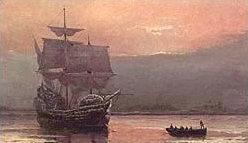
It wasn't until 1840 that the term "Pilgrim" came to refer to the early Mayflower settlers.
The Pilgrims (though they weren't called that at the time) originated with the members of a Separatist congregation from Scrooby, Nottinghamshire, England, whose pastors were Richard Clifton and John Robinson.1 This congregation suffered difficult persecution in England because they dissented from the state Church of England. William Bradford, one of the original Mayflower emigrants, wrote that
"[The church members] were hunted and persecuted on every side, so as their former afflictions were as flea-bitings in comparison of these which now came upon them. For some were taken and clapt up in prison, others had their houses besett and watcht night and day, and hardly escaped their hands; and the most were faine to flie and leave their howses and habitations, and the means of their livelihood... Yet, seeing themselves thus molested, and that there was no hope of their continuance there, but a joynt consent, they resolved to goe into the Low Countries, where they heard was freedom of religion for all men...."2
The congregation moved to Holland in 1607 where religious freedom was greater. Some who were in prison, didn't get there for another year.
They settled in Amsterdam for a year, but then moved to Leiden, Holland, where they lived for a dozen years. But life was difficult for these expatriates. As foreigners they were deprived of a chance at the best jobs, and struggled to maintain even a low standard of living. Times were tough. But what caused them to move were their teenagers. They had religious freedom, but
"Many of their children by the great licentiousness of youth in that countrie, and the manifold temptations of the place, were drawne away by evill examples into extravagante and dangerous courses."3
They were losing their young people and struggling at the bottom of the economic scale. If they returned to England they faced severe persecution and imprisonment. So in 1620 many from the congregation decided to emigrate to America, to the New World. Three groups came on the Mayflower:
- Saints — members of the Separatist Leiden congregation,
- Strangers — members of the Church of England who were emigrating for economic reasons, and
- Crew Members — seamen aboard the Mayflower, some of whom were contracted to work in the Plymouth Colony for a year or longer.
The "strangers" weren't non-Christians. They were probably members of the Church of England and would count themselves as Christians. But they didn't share the Separatists' refusal to be a part of what they considered to be the corrupt state church.
We ought to make a couple of distinctions here. Strictly speaking, Separatists were pious Christians who had given up on the Church of England and formed their own congregations. Puritans, on the other hand, were members of the Church of England who wanted to purify the Church from its worldliness and corruption. Instead of separating (in the early days), they formed religious societies within Anglican congregations. A number of these groups, like the Mayflower group, fled to Holland. They were the beginnings of the Congregationalist and Baptist churches that put down early roots in America.
Though the Plymouth Colony was the first Separatist colony in New England, the Puritan Massachusetts Bay Colony was established by royal charter in 1629. But apparently the Massachusetts Puritans had something in common with the Plymouth Separatists even before they sailed for America — the autonomy of the local congregation and a restriction of membership to "those predestined to be God's elect."4 As time went on the churches in Plymouth and the Massachusetts Bay Colony came to resemble each other.
But the Plymouth colonists still weren't called Pilgrims, not for many years, not until 1840. At that point someone resurrected William Bradford's original phrase describing the Saints that had left Leiden to travel aboard the Mayflower to the New World. They left Leiden, he said, "that goodly & pleasante citie which had been their resting place for near 12 years; but they knew they were pilgrimes, & looked not much on those things, but lift up their eyes to ye heavens, their dearest cuntrie, and quieted their spirits."5
Since the 1840s the Mayflower settlers have been referred to as the Pilgrims, echoing the verse from the Bible that Bradford had in mind:
"These all died in faith, not having received the promises, but having seen them afar off, and were persuaded of them, and embraced them, and confessed that they were strangers and pilgrims on the earth. For they that say such things declare plainly that they seek a country. And truly, if they had been mindful of that country from whence they came out, they might have had opportunity to have returned. But now they desire a better country, that is, an heavenly: wherefore God is not ashamed to be called their God: for he hath prepared for them a city" (Hebrews 11:13-16, KJV).
The Night Before Thanksgiving
By Sarah Orne Jewett (published in 1905 and now in the Public Domain)
I
There was a sad heart in the low-storied, dark little house that stood humbly by the roadside under some tall elms. Small as her house was, old Mrs. Robb found it too large for herself alone; she only needed the kitchen and a tiny bedroom that led out of it, and there still remained the best room and a bedroom, with the low garret overhead.
There had been a time, after she was left alone, when Mrs. Robb could help those who were poorer than herself. She was strong enough not only to do a woman's work inside her house, but almost a man's work outside in her piece of garden ground. At last sickness and age had come hand in hand, those two relentless enemies of the poor, and together they had wasted her strength and substance. She had always been looked up to by her neighbors as being independent, but now she was left, lame-footed and lame-handed, with a debt to carry and her bare land, and the house ill-provisioned to stand the siege of time.
For a while she managed to get on, but at last it began to be whispered about that there was no use for any one so proud; it was easier for the whole town to care for her than for a few neighbors, and Mrs. Robb had better go to the poorhouse before winter, and be done with it. At this terrible suggestion her brave heart seemed to stand still. The people whom she cared for most happened to be poor, and she could no longer go into their households to make herself of use. The very elms overhead seemed to say, "Oh, no!" as they groaned in the late autumn winds, and there was something appealing even to the strange passer-by in the look of the little gray house, with Mrs. Robb's pale, worried face at the window.
II
Some one has said that anniversaries are days to make other people happy in, but sometimes when they come they seem to be full of shadows, and the power of giving joy to others, that inalienable right which ought to lighten the saddest heart, the most indifferent sympathy, sometimes even this seems to be withdrawn.
So poor old Mary Ann Robb sat at her window on the afternoon before Thanksgiving and felt herself poor and sorrowful indeed. Across the frozen road she looked eastward over a great stretch of cold meadow land, brown and wind-swept and crossed by icy ditches. It seemed to her as if before this, in all the troubles that she had known and carried, there had always been some hope to hold: as if she had never looked poverty full in the face and seen its cold and pitiless look before. She looked anxiously down the road, with a horrible shrinking and dread at the thought of being asked, out of pity, to join in some Thanksgiving feast, but there was nobody coming with gifts in hand. Once she had been full of love for such days, whether at home or abroad, but something chilled her very heart now.
Her nearest neighbor had been foremost of those who wished her to go to the town farm, and he had said more than once that it was the only sensible thing. But John Mander was waiting impatiently to get her tiny farm into his own hands; he had advanced some money upon it in her extremity, and pretended that there was still a debt, after he cleared her wood lot to pay himself back. He would plough over the graves in the field corner and fell the great elms, and waited now like a spider for his poor prey. He often reproached her for being too generous to worthless people in the past and coming to be a charge to others now. Oh, if she could only die in her own house and not suffer the pain of homelessness and dependence!
It was just at sunset, and as she looked out hopelessly across the gray fields, there was a sudden gleam of light far away on the low hills beyond; the clouds opened in the west and let the sunshine through. One lovely gleam shot swift as an arrow and brightened a far cold hillside where it fell, and at the same moment a sudden gleam of hope brightened the winter landscape of her heart.
"There was Johnny Harris," said Mary Ann Robb softly. "He was a soldier's son, left an orphan and distressed. Old John Mander scolded, but I couldn't see the poor boy in want. I kept him that year after he got hurt, spite o' what anybody said, an' he helped me what little he could. He said I was the only mother he 'd ever had. 'I'm goin' out West, Mother Robb,' says he. 'I sha'n't come back till I get rich,' an' then he'd look at me an' laugh, so pleasant and boyish. He wa'n't one that liked to write. I don't think he was doin' very well when I heard,—there, it's most four years ago now. I always thought if he got sick or anything, I should have a good home for him to come to. There 's poor Ezra Blake, the deaf one, too,— he won't have any place to welcome him."
The light faded out of doors, and again Mrs. Robb's troubles stood before her. Yet it was not so dark as it had been in her sad heart. She still sat by the window, hoping now, in spite of herself, instead of fearing; and a curious feeling of nearness and expectancy made her feel not so much light-hearted as light-headed.
"I feel just as if somethin' was goin' to happen," she said. "Poor Johnny Harris, perhaps he's thinkin' o' me, if he's alive."
It was dark now out of doors, and there were tiny clicks against the window. It was beginning to snow, and the great elms creaked in the rising wind overhead.
III
A dead limb of one of the old trees had fallen that autumn, and, poor firewood as it might be, it was Mrs. Robb's own, and she had burnt it most thankfully. There was only a small armful left, but at least she could have the luxury of a fire. She had a feeling that it was her last night at home, and with strange recklessness began to fill the stove as she used to do in better days.
"It'll get me good an' warm," she said, still talking to herself, as lonely people do, "an' I'll go to bed early. It's comin' on to storm."
The snow clicked faster and faster against the window, and she sat alone thinking in the dark.
"There's lots of folks I love," she said once. "They'd be sorry I ain't got nobody to come, an' no supper the night afore Thanksgivin'. I'm dreadful glad they don't know." And she drew a little nearer to the fire, and laid her head back drowsily in the old rocking-chair.
It seemed only a moment before there was a loud knocking, and somebody lifted the latch of the door. The fire shone bright through the front of the stove and made a little light in the room, but Mary Ann Robb waked up frightened and bewildered.
"Who's there?" she called, as she found her crutch and went to the door. She was only conscious of her one great fear. "They've come to take me to the poor-house!" she said, and burst into tears.
There was a tall man, not John Mander, who seemed to fill the narrow doorway.
"Come, let me in!" he said gayly. "It's a cold night. You didn't expect me, did you, Mother Robb?"
"Dear me, what is it?" she faltered, stepping back as he came in, and dropping her crutch. "Be I dreamin'? I was a-dreamin' about— Oh, there! What was I a-sayin'? 'T ain't true! No! I've made some kind of a mistake."
Yes, and this was the man who kept the poorhouse, and she would go without complaint; they might have given her notice, but she must not fret.
"Sit down, sir," she said, turning toward him with touching patience. "You 'll have to give me a little time. If I 'd been notified I wouldn't have kept you waiting a minute this stormy night."
It was not the keeper of the poorhouse. The man by the door took one step forward and put his arm round her and kissed her.
"What are you talking about?" said John Harris. "You ain't goin' to make me feel like a stranger? I've come all the way from Dakota to spend Thanksgivin'. There's all sorts o' things out here in the wagon, an' a man to help get 'em in. Why, don't cry so, Mother Robb. I thought you 'd have a great laugh, if I come and surprised you. Don't you remember I always said I should come?"
It was John Harris, indeed. The poor soul could say nothing. She felt now as if her heart was going to break with joy. He left her in the rocking-chair and came and went in his old boyish way, bringing in the store of gifts and provisions. It was better than any dream. He laughed and talked, and went out to send away the man to bring a wagonful of wood from John Mander's, and came in himself laden with pieces of the nearest fence to keep the fire going in the mean time. They must cook the beef-steak for supper right away; they must find the pound of tea among all the other bundles; they must get good fires started in both the cold bedrooms. Why, Mother Robb didn't seem to be ready for company from out West! The great, cheerful fellow hurried about the tiny house, and the little old woman limped after him, forgetting everything but hospitality. Had not she a house for John to come to? Were not her old chairs and tables in their places still? And he remembered everything, and kissed her as they stood before the fire, as if she were a girl.
He had found plenty of hard times, but luck had come at last. He had struck luck, and this was the end of a great year.
"No, I couldn't seem to write letters; no use to complain o' the worst, an' I wanted to tell you the best when I came;" and he told it while she cooked the supper. "No, I wa'n't goin' to write no foolish letters," John repeated. He was afraid he should cry himself when he found out how bad things had been; and they sat down to supper together, just as they used to do when he was a homeless orphan boy, whom nobody else wanted in winter weather while he was crippled and could not work. She could not be kinder now than she was then, but she looked so poor and old! He saw her taste her cup of tea and set it down again with a trembling hand and a look at him. "No, I wanted to come myself," he blustered, wiping his eyes and trying to laugh. "And you 're going to have everything you need to make you comfortable long's you live, Mother Robb!"
She looked at him again and nodded, but she did not even try to speak. There was a good hot supper ready, and a happy guest had come; it was the night before Thanksgiving.
Thanksgiving Humor
Turkey Puns
- What key has legs and can’t open a door? A turkey.
- What do you call a turkey that’s been to the gym? A putter-ball.
- Why did the turkey become a percussionist? It already had the drumsticks.
- What sound does a turkey’s phone make? Wing, wing, wing.
- What do you call a rude turkey? A jerk-y.
- Why was the turkey in jail? They suspected fowl play.
- What did the turkey say to the hunter? Quack, quack.
- What do you get when you cross a turkey with a ghost? A poultry-geist.
Food & Side Dish Humor
- What do sweet potatoes wear to bed? Yammies.
- Why did the mashed potatoes cross the road? To get to the other sides.
- What do you call a sad cranberry? A blueberry.
- Why did the cranberries turn red? They saw the turkey dressing.
- What’s a pumpkin’s favorite sport? Squash.
- Why was the Thanksgiving soup so expensive? It had 24 carrots.
- What did the mother turkey say to her disobedient children? If your father could see you now, he’d turn over in his gravy.
- What do you call a polite turkey? A thank-you bird.